
Quick answer: Stock for your planned bookings before opening, not for every service you might offer one day. In the first 30 days, count what you actually use. By day 90, turn those counts into par levels and standing orders. Before you open, read your college's aesthetics guidance and your province's public health and workplace rules; the links are below.
This article covers supplies and operations. It is not legal advice. Follow your college's standards, the product's instructions for use, and your medical director.
What should a 90-day supply plan cover?
Three stages, each with one job.
| Stage | Timing | The job |
|---|---|---|
| Opening stock | About 30 days before opening to day 0 | Stock for planned bookings, plus emergency readiness |
| Learn | Days 1 to 30 | Replace estimates with real counts |
| Settle | Days 31 to 90 | Set par levels, standing orders and a review rhythm |
What do I order before opening day?
Start from the services you will actually book in the first month. For each one, list the consumables used per appointment, then multiply by your planned appointments until your second delivery. Add a buffer for busy days.
| Category | Typical items | Note |
|---|---|---|
| Injection supplies | Syringes, needles or cannulas matched to your services | Check each device's Health Canada licence (Class II to IV) |
| Skin preparation | Chlorhexidine and alcohol wipes, alcohol swabs | Follow the product's instructions for use |
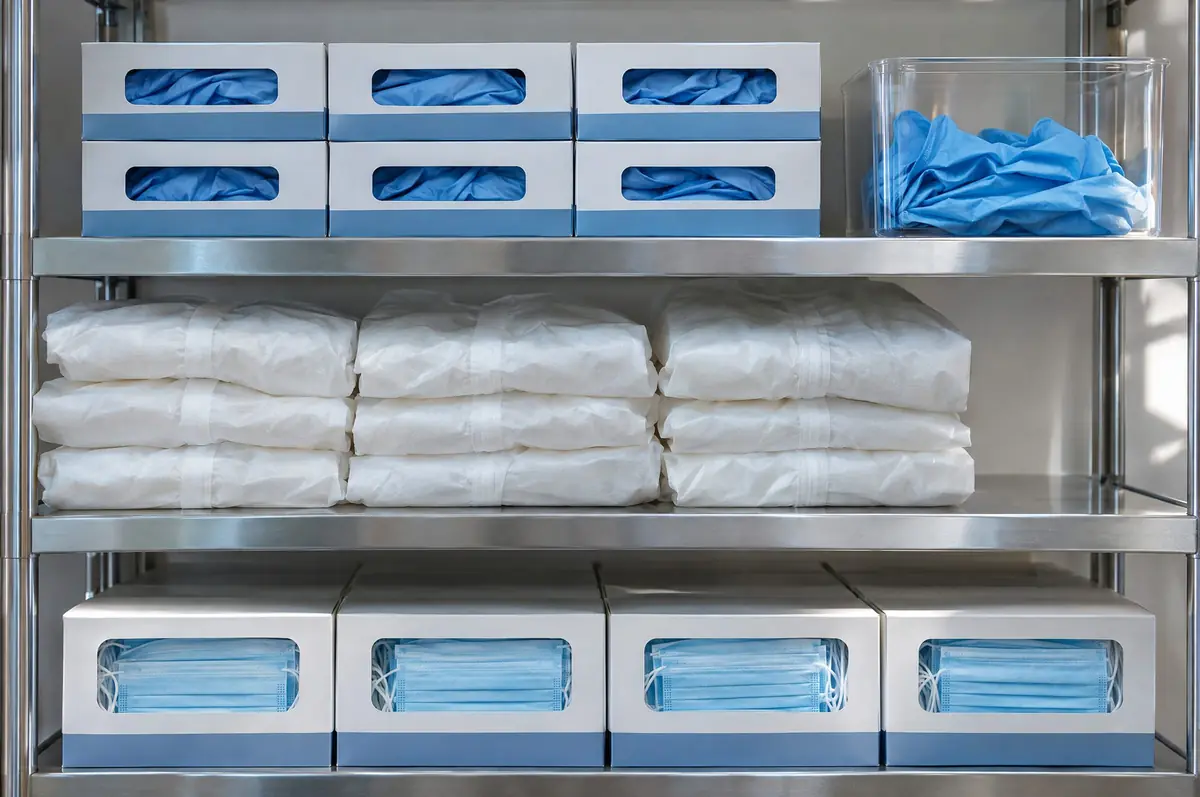
| Personal protective equipment | Examination gloves, procedure masks | Size range for every clinician |
| Gauze, wipes and cotton | Non-woven gauze, esthetic wipes, cotton rounds | Non-sterile and sterile as your procedures require |
| Dressings and tape | Small adhesive bandages, transparent film dressings, gentle tape | |
| Sharps | A sharps container at every point of use | See the Ontario guidance below |
| Emergency readiness | Items chosen by your medical director | See our emergency-readiness checklist |
| Client comfort | Headbands, underpads, disposable garments if relevant | |
| Records | A receiving log for lot and expiry | See our lot record guide |
A simple opening formula: planned appointments per day x units per appointment x clinic days until your second delivery, plus a buffer. The worked examples in our par level and cost-per-treatment guides show the math.
Days 1 to 30: how do I replace guesses with counts?
- Count weekly. Same day, same time, same person.
- Note the misses. Anything you ran short of, and anything you never opened.
- Log every delivery. Product, lot, expiry, quantity.
- Watch expiry on slow movers. If something will expire before you use it, order less next time.
Days 31 to 90: how do I settle into a rhythm?
- Set par levels from your four weeks of counts.
- Move steady items to a standing order. Gloves, wipes, gauze and syringes are usually the first.
- Keep emergency items on a signed check, not on auto-ship.
- Review once a quarter, or whenever you add a service or a clinician.
Which regulatory resources should I read before opening?
Rules differ by province and profession. Below are official sources, with a short quote from each, so you can go straight to the document that applies to you.
Health Canada (all provinces)
Medical Devices Regulations, s. 26: "no person shall import or sell a Class II, III or IV medical device unless the manufacturer of the device holds a licence in respect of that device." Check devices in the Medical Devices Active Licence Listing (MDALL).
Ontario
College of Nurses of Ontario (CNO), Aesthetic Services practice guideline (June 2026): employer policies should outline that "all drugs, substances, products and equipment used are Health Canada-approved."
CNO practice standards update (approved by CNO Council on September 24, 2026; updated standards published November 6, 2026): from Monday, March 1, 2027, nurses in aesthetic services must "use client-specific orders instead of directives for aesthetic services involving prescription drugs or controlled acts" and, when they delegate a controlled act, be "onsite for the entire delegated procedure." If you open before then, plan for the change.
College of Physicians and Surgeons of Ontario (CPSO), Infection Prevention and Control for Clinical Office Practice policy (September 2024): "Physicians must undertake infection prevention and control practices, in line with the Provincial" Infectious Diseases Advisory Committee's best-practice document.
CPSO Out-of-Hospital Premises Inspection Program: its listed cosmetic procedure domains include "Injection/Insertion of Permanent Filler, Substance or Autologous Tissue" and "Liposuction." Check whether your planned services fall under it.
Ontario Regulation 136/18, Personal Service Settings: an operator "shall provide notice, in writing, of the intention to the medical officer of health" at least 14 days before opening. The regulation excludes settings where services are "primarily provided by a member of a health profession" engaged in the practice of that profession.
Ontario Regulation 474/07, Needle Safety: applies when "A worker is to do work requiring the use of a hollow-bore needle on a person for a therapeutic, preventative, palliative, diagnostic or cosmetic purpose, in any workplace."
Workplace Safety and Insurance Board (WSIB), First Aid Program: "You must have at least one person on site at all times who has a valid first aid certificate."
British Columbia
BC College of Nurses and Midwives (BCCNM), Medical aesthetics (updated June 11, 2026): "Follow employer's policies or ensure you have appropriate policies if you are self-employed."
College of Physicians and Surgeons of British Columbia (CPSBC), Injection of Botulinum Toxin, Dermal Fillers and Venous Sclerotherapy (version 4.3, revised April 1, 2026): "the ordering licensee or another licensee who has assumed responsibility must be present within the facility and immediately available for consultation."
Alberta
College of Registered Nurses of Alberta (CRNA), Injectable Cosmetic Therapies: Practice Advice for Registered Nurses (December 12, 2025): "Registrants must ensure adequate resources are in place for managing complications."
Manitoba
College of Registered Nurses of Manitoba (CRNM), Practice Direction: Medical Aesthetics (published 10/2025): "Renting or leasing a clinical space, room, or chair does not absolve the registrant of their practice expectations."
New Brunswick
Nurses Association of New Brunswick (NANB), Medical Aesthetics (December 2024): "Proper equipment and employer policies must be in place to support nursing practice and ensure client safety."
Practising in another province or territory? Start with your own regulatory college's website and its current aesthetics guidance.
How does Kleos help a new clinic?
Kleos Launch is our new-clinic program. It starts from the services you plan to offer and turns them into a supply list, then helps you move steady items onto Always Stocked™ once your real counts are in. Every device page on Kleos Shop shows its Health Canada licence number, and lot numbers can be requested after ordering.
Questions clinics ask
How much stock should I open with?
Enough for your planned bookings until your second delivery, plus a buffer for your busiest days. Stocking for every possible service ties up cash and risks expiry.
Which items should go on a standing order first?
High-use, low-risk consumables: gloves, wipes, gauze and syringes. Wait until you have two to four weeks of real counts.
Do I need to notify public health before opening?
In Ontario, personal service settings must give 14 days' written notice to the medical officer of health, with exclusions for regulated health professionals practising their profession. Other provinces differ. Check with your local public health unit.
Can I offer aesthetic procedures in clients' homes?
Rules vary. Manitoba's nursing college states that mobile procedures in a client's home or at group events "are not considered appropriate practice settings." Check your own college.
Is this legal advice?
No. It points you to official sources. For decisions about your clinic, speak with your college and a qualified advisor.
Sources
- Medical Devices Regulations (SOR/98-282), s. 26. laws-lois.justice.gc.ca
- College of Nurses of Ontario. Aesthetic Services practice guideline. June 2026. cno.org
- College of Physicians and Surgeons of Ontario. Infection Prevention and Control for Clinical Office Practice (policy). September 2024. cpso.on.ca
- College of Physicians and Surgeons of Ontario. Out-of-Hospital Premises Inspection Program: Domains of Procedure Oversight. cpso.on.ca
- Ontario Regulation 136/18, Personal Service Settings, ss. 2(2), 3(1). ontario.ca
- Ontario Regulation 474/07, Needle Safety, s. 2(1). ontario.ca
- Workplace Safety and Insurance Board. First Aid Program. wsib.ca
- BC College of Nurses and Midwives. Medical aesthetics (RN). Updated June 11, 2026. bccnm.ca
- College of Physicians and Surgeons of British Columbia. Practice Standard: Injection of Botulinum Toxin, Dermal Fillers and Venous Sclerotherapy. Version 4.3, April 1, 2026. cpsbc.ca
- College of Registered Nurses of Alberta. Injectable Cosmetic Therapies: Practice Advice for Registered Nurses. December 12, 2025. nurses.ab.ca
- College of Registered Nurses of Manitoba. Practice Direction: Medical Aesthetics. 10/2025. crnm.mb.ca
- Nurses Association of New Brunswick. Medical Aesthetics. December 2024. nanb.nb.ca
- College of Nurses of Ontario. CNO updates practice standards to strengthen client safety. November 6, 2026. cno.org