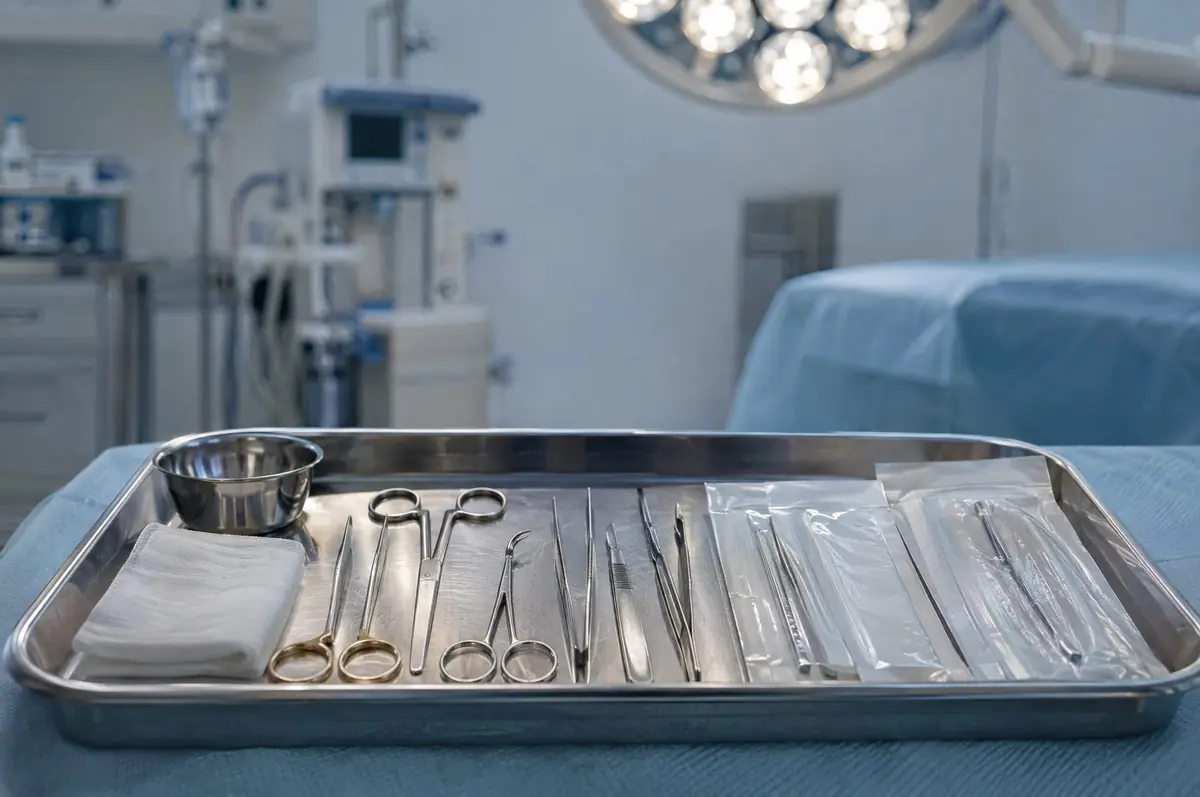

Quick answer: A peripheral intravenous (IV) start needs nine groups of supplies: hand hygiene, clean gloves, a tourniquet, skin antiseptic, an IV catheter, an administration set, a bag of 0.9% sodium chloride, a sterile transparent dressing with securing tape, and a sharps container within reach. Lay them out before you approach the client, so nothing is fetched mid-procedure.
This checklist covers supplies for starting a peripheral line. It does not cover what is infused, rates or drugs. Follow your college's standards, the product's instructions for use, your employer's policy and your medical director.
What goes on the tray?
| # | Item | What to look for | Guidance |
|---|---|---|---|
| 1 | Alcohol-based hand rub | At point of care | CDC: "Hand hygiene should be performed before and after palpating catheter insertion sites" |
| 2 | Clean examination gloves | Correct size | CDC: clean gloves are acceptable "if the access site is not touched after the application of skin antiseptics" |
| 3 | Tourniquet | Single-patient use, per your policy | Employer policy |
| 4 | Skin antiseptic | Chlorhexidine with alcohol, or as your policy specifies | CDC and PIDAC, below |
| 5 | IV catheter | Gauge and length chosen by the clinician | Health Canada licensed; safety-engineered where required |
| 6 | IV administration set | Drop factor, length, connector | Product instructions for use |
| 7 | 0.9% sodium chloride injection | Bag size, intact container, in date | Product monograph |
| 8 | Sterile transparent dressing and tape | Size to cover the site | CDC, below |
| 9 | Sharps container | Within reach, below the fill line | PIDAC, below |
Also useful: 2 x 2 gauze, an underpad, and labels for date and time, as your policy requires.
Which skin antiseptic should be on the tray?
The US Centers for Disease Control and Prevention (CDC) Guidelines for the Prevention of Intravascular Catheter-Related Infections (2011, with 2017 updates) recommend: "Prepare clean skin with an antiseptic (70% alcohol, tincture of iodine, or alcoholic chlorhexidine gluconate solution)" before peripheral venous catheter insertion (Category IB). They add: "Antiseptics should be allowed to dry according to the manufacturer's recommendation prior to placing the catheter" (Category IB).
Ontario's Provincial Infectious Diseases Advisory Committee (PIDAC) lists "2 per cent chlorhexidine gluconate (CHG) in 70 per cent isopropyl alcohol" among skin preparations and notes that "an antiseptic must be allowed to dry after application."
On Kleos Shop, the 3M SoluPrep Small Wipe contains 2% w/v chlorhexidine gluconate and 70% v/v isopropyl alcohol (Drug Identification Number, DIN, 02385708). Each single-use wipe holds 0.65 mL and is labelled for use on intact skin prior to medical or surgical invasive procedures.
Which IV catheters are on Kleos Shop?
All four below are Health Canada licensed Class II devices. The clinician chooses gauge and length.
| Catheter | Gauge x length | Hub colour | Manufacturer flow rate | Health Canada licence |
|---|---|---|---|---|
| BD Angiocath IV Catheter | 20 G x 1.88 in (48 mm) | Pink | 42 mL/min | 9493 |
| BD Angiocath IV Catheter | 24 G x 0.75 in (19 mm) | Yellow | 17 mL/min | 9493 |
| BD Nexiva Closed IV Catheter System, single port | 22 G x 1.75 in (44 mm) | Blue | 33 mL/min | 106961 |
| Jelco ProtectIV Safety IV Catheter | 22 G x 1 in | Blue | 38 mL/min | 4733 |
The manufacturer describes the ProtectIV as "designed to protect the healthcare worker from risk of accidental needlestick injuries."
Do I need safety-engineered catheters?
In Ontario, it can be a legal requirement for employers. Ontario Regulation 474/07, Needle Safety, applies when "A worker is to do work requiring the use of a hollow-bore needle on a person for a therapeutic, preventative, palliative, diagnostic or cosmetic purpose, in any workplace." Section 3(1) says "the employer shall provide the worker with a safety-engineered needle that is appropriate for the work." The regulation defines a safety-engineered needle as one that "is designed to eliminate or minimize the risk of a skin puncture injury to the worker" and "is licensed as a medical device by Health Canada."
Other provinces have their own occupational health and safety rules. Check yours, and ask your supplier which catheters are safety-engineered.
What should the administration set include?
The B. Braun Basic IV Administration Set (ref 352601, Health Canada licence 13508) is a gravity set with a 15 drops/mL drop factor, an 85 in (216 cm) length, a 13 mL priming volume, a universal spike, roller clamp, slide clamp and SPIN-LOCK connector. It has no injection ports. Check that the connector matches your catheter or extension.
Which saline bag?
0.9% sodium chloride injection is a drug product with a DIN, not a medical device. Health Canada's Drug Product Database lists ICU Medical's Sodium Chloride Injection USP under DIN 00037842. Kleos Shop carries it in 250 mL and 500 mL bags, sold by the case of 24. Check the expiry date and container integrity, and follow the product monograph.
How should the site be dressed?
The CDC recommends: "Use either sterile gauze or sterile, transparent, semipermeable dressing to cover the catheter site" (Category IA).
| Dressing | Size | Pack | Health Canada licence |
|---|---|---|---|
| 3M Tegaderm Transparent Film Dressing 1624W | 6 x 7 cm | Box of 100 | 77881 (Class II) |
| 3M Tegaderm Transparent Film Dressing 1626W | 10 x 12 cm | Box of 50 | 77881 (Class II) |
The manufacturer lists covering and protecting I.V. catheter sites among Tegaderm's suggested applications. For securing tubing, the manufacturer lists 3M Transpore Surgical Tape for IV lines and tubing (secondary securement) on intact skin. Mepitac Soft Silicone Fixation Tape is described by its manufacturer as designed for fixation of IV cannulae and "atraumatic to the skin on removal."
Where do sharps go?
PIDAC says: "Sharps shall be discarded into a puncture-resistant, tamper-resistant, leak-proof container," with containers "easily accessible in every 'point of use' area," and sealed and replaced at "the fill line marked on the container." The compact Monoject Phlebotomy Sharps Container, 1 qt is designed to fit into blood-drawing trays, so used needles can be discarded at the point of use.
Questions clinics ask
Sterile or clean gloves for a peripheral IV start?
The CDC says clean gloves rather than sterile gloves can be worn "if the access site is not touched after the application of skin antiseptics." Follow your employer's policy.
Is 0.9% saline a medical device?
No. It is a drug product with a DIN. Kleos Shop sells it to approved clinic accounts.
Which gauge should I stock?
That is a clinical decision for your team. Keeping more than one gauge on hand lets the clinician choose.
Do I need a safety catheter?
In Ontario, employers must provide safety-engineered needles where the Needle Safety regulation applies. Check your province's rules.
What size Tegaderm fits a peripheral site?
The 1624W (6 x 7 cm) is the smaller frame-style option; the 1626W (10 x 12 cm) covers a larger area. Choose by site and securement needs.
Sources
- US Centers for Disease Control and Prevention. Guidelines for the Prevention of Intravascular Catheter-Related Infections, 2011 (with 2017 updates). cdc.gov
- Provincial Infectious Diseases Advisory Committee (PIDAC), Public Health Ontario. Infection Prevention and Control for Clinical Office Practice, 1st revision, April 2015, sections 6.G and 13. publichealthontario.ca
- Ontario Regulation 474/07, Needle Safety, ss. 1, 2, 3. ontario.ca
- Health Canada. Drug Product Database: DIN 00037842 (Sodium Chloride Injection USP, ICU Medical Canada Inc.) and DIN 02385708 (SoluPrep Wipe, Solventum Canada Limited). health-products.canada.ca
- Health Canada. Medical Devices Active Licence Listing: licences 9493, 106961, 4733, 13508, 77881. health-products.canada.ca
- Manufacturer product information held by Kleos Health: BD Angiocath and Nexiva specifications; Jelco ProtectIV family brochure; B. Braun 352601 specifications; 3M SoluPrep brochure; 3M Tegaderm product guide; Monoject container brochures.